
Introduction
The Cape Mounted Rifles, a historic regiment with a legacy dating back to the early 19th century, holds a prominent place in the military history of South Africa. This esteemed unit has played a vital role in safeguarding the country's frontier regions, contributing to its rich and diverse heritage. In this article, we will delve into the history, evolution, and significance of the Cape Mounted Rifles.
A Brief Historical Overview
The Cape Mounted Rifles (CMR) originated in the Cape Colony, which was established by the Dutch in the 17th century and later came under British control during the Napoleonic Wars. The early 1800s were marked by territorial expansion and conflicts along the Cape Colony's frontiers. In response to these challenges, local militias were formed, and the Cape Mounted Rifles emerged as a skilled and adaptable cavalry unit.
Formation and Early Years
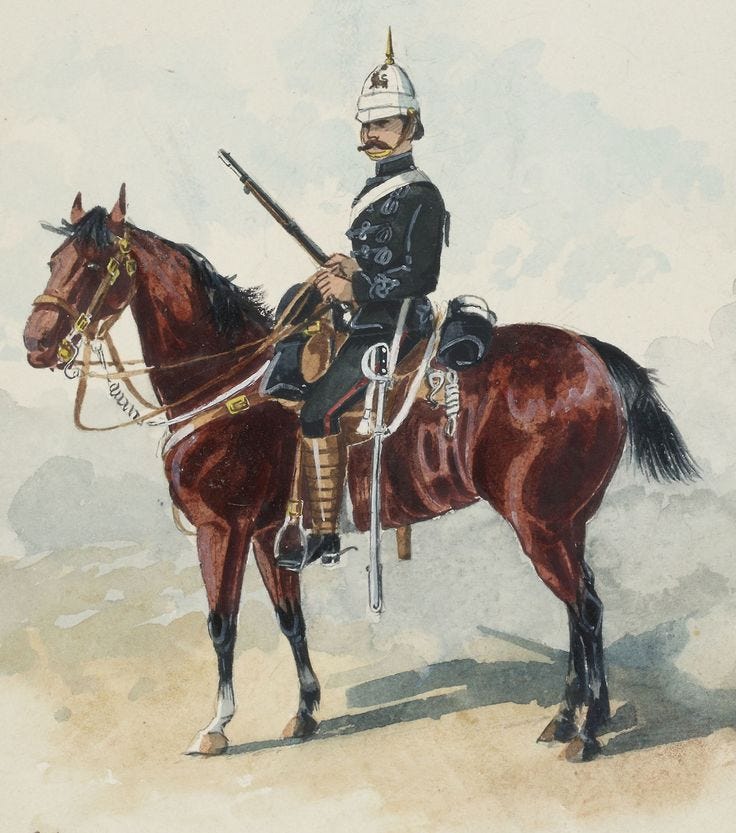
The Imperial Cape Mounted Rifleman (CMR) was originally raised as the Cape Regiment in 1806, with the officers being British and the other ranks Khoi or ‘coloured’. In 1827 the corps, generally known as the Cape Corps, was reformed as the CMR (Imperial) and served until 1870 when it was disbanded in England.
The Colonial CMR was raised in 1855 as the Frontier Armed & Mounted Police (FAMP) and deliberately changed its name to that of the older, Imperial CMR regiment in 1878. In 1913 the name changed again to the First Regiment, South African Mounted Rifles which was disbanded in 1926.
They were primarily tasked with patrolling and protecting the colony's eastern and northern borders, which were prone to raids by indigenous Xhosa tribes and other external threats. These early years saw the CMR develop a reputation for their horsemanship, marksmanship, and discipline.
Role in the Frontier Wars
The CMR played a crucial role in the Frontier Wars, a series of conflicts between European settlers and Xhosa tribes that spanned from the late 18th century to the mid-19th century. During these wars, the CMR engaged in both defensive and offensive operations. Their mobility and knowledge of the terrain made them effective in the harsh and often remote frontier areas.
The Fifth Basuto War from 1880 to 1881
It was during this time that John Downham enters the conflict as evident from his military records for which he received a medal for his service in the Basuto War. This is the account of the war from the book, Record of the Cape Mounted Rifleman.
The year 1880 was a critical time for British supremacy in South Africa, for it saw the revolt of the Transvaal Boers and Majuba, the outbreak of the fifth Basuto war, another rising of the Pondomisi in the Transkei, and the recall of Sir Bartle Frere. With the Transvaal insurrection the CMR were not called upon to deal, but they took the leading part in the Basuto war. It will be remembered that Basutoland, which was annexed by the Imperial Government in 1868, had in 1871 been handed over to Cape Colony. The Colony, which only received responsible government itself in the same year, had almost more than it could do in attempting to keep order among the turbulent Basutos, who in exchange for labour at Kimberley are stated to have acquired 18,000 good rifles. An Act was passed to disarm them, and Mr Sprigg, the Premier, held a “Pitso”, or meeting, at Maseru in 1879 to explain its provisions to them. The Basutos naturally resented this proposal, all the more as some of their armed parties had given assistance against Moirossi. Letsie, however, Moshesh’s son and successor as paramount chief, professed his submission in 1880, but Letsie’s sons, chief of whom was Lerothodi, openly refused to abide by his decision and took up arms against him. In view of their threatening attitude troops where moved into the country.
The South African War (1899-1902)
The Cape Mounted Rifles continued to evolve and adapt to changing circumstances. During the South African War, also known as the Anglo-Boer War, the CMR expanded their role beyond border security. They fought alongside British forces in various engagements, showcasing their versatility in both mounted and dismounted combat. Their participation in this war highlighted the CMR's dedication and valor.
Post-Union Period
After the formation of the Union of South Africa in 1910, the Cape Mounted Rifles was reorganized into a part-time Citizen Force unit. They continued to play a vital role in the defense of South Africa, especially during World War I and World War II. During these conflicts, CMR personnel served alongside other South African units in theaters of war around the world.
Modern Era
In the post-World War II period, the Cape Mounted Rifles experienced a series of restructurings and changes in their role. They adapted to new security challenges and played a role in internal security operations during the apartheid era.
Today, the Cape Mounted Rifles remains an integral part of the South African National Defence Force (SANDF). While their role has shifted over the years to adapt to changing security dynamics, they continue to serve as a symbol of South Africa's military heritage and commitment to defense.
Conclusion
The Cape Mounted Rifles have a long and storied history, dating back to the early days of the Cape Colony. From their formation to their participation in significant conflicts, they have consistently demonstrated their dedication to protecting South Africa's frontiers. The CMR's ability to adapt and evolve over the years reflects their resilience and commitment to serving their nation. They remain an essential part of South Africa's military tradition and continue to contribute to the country's security in the modern era.
